
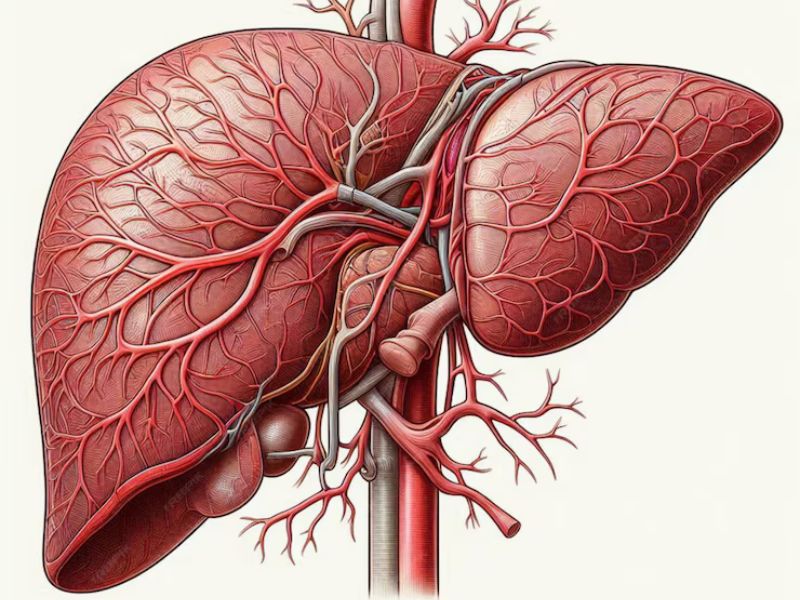
Biochemical and liver function tests
Common blood tests to assess liver health include liver enzyme levels (alanine aminotransferase [ALT], aspartate aminotransferase [AST], alkaline phosphatase, gamma-glutamyl transpeptidase). Tests of hepatic synthetic function (albumin, prothrombin time/international normalized ratio [INR]) and serum bilirubin.
- Initial evaluation of abnormal biochemical and liver function test results: The initial evaluation involves gathering a history to identify potential risk factors for liver disease and performing a physical examination to look for clues about the etiology and signs of chronic liver disease. Further tests are determined based on the information gathered during the history and physical examination, as well as the pattern of abnormal liver test results.
Patterns of abnormal liver test results
Abnormalities in liver biochemical tests can often be grouped into one of the following patterns: hepatocellular, cholestatic, or isolated hyperbilirubinemia. Patients with hepatocellular injury typically have a disproportionate elevation of serum aminotransferases compared to alkaline phosphatase, while patients with a cholestatic process exhibit the opposite results.
Serum bilirubin can be markedly elevated in both hepatocellular and cholestatic injuries and is therefore not necessarily useful for differentiating between the two. Abnormal synthetic function tests can be observed in both hepatocellular injury and cholestasis.
Patients with elevated serum aminotransferases
In the case of hepatocellular damage, ALT and AST are released from hepatocytes, leading to increased serum concentrations. The differential diagnosis of elevated serum aminotransferases is broad and includes viral hepatitis, hepatotoxicity due to drugs or toxins, alcoholic liver disease, hepatic ischemia, and malignant infiltration.
The evaluation should consider the patient's risk factors for liver disease as well as physical examination findings that might point to a particular diagnosis. The evaluation often includes testing for viral hepatitis and autoimmune disease. In some cases, a liver biopsy may be necessary.
Patients with cholestasis
The disease may occur in the case of extrahepatic or intrahepatic bile duct obstruction. In patients with cholestasis, alkaline phosphatase is typically elevated at least four times the upper limit of normal. Lesser degrees of elevation are nonspecific and can be observed in many other liver diseases, such as viral hepatitis, infiltrative liver diseases, and congestive hepatopathy.
Patients with a primarily cholestatic pattern are usually subjected to a ultrasound of the right upper quadrant to further characterize the cholestasis as intra- or extrahepatic.
The presence of biliary dilation on ultrasound suggests extrahepatic cholestasis, which may be due to gallstones, strictures, or cancer. The absence of biliary dilation suggests intrahepatic cholestasis. There are many possible causes of intrahepatic cholestasis, including drug toxicity, primary biliary cholangitis, primary sclerosing cholangitis, viral hepatitis, pregnancy cholestasis, benign postoperative cholestasis, infiltrative diseases, and total parenteral nutrition.
Further tests to identify the underlying cause may include testing for antimitochondrial antibodies, magnetic resonance cholangiopancreatography, computed tomography, endoscopic ultrasound, and/or endoscopic retrograde cholangiopancreatography.
Patients with isolated hyperbilirubinemia
The evaluation of isolated hyperbilirubinemia begins with determining whether the hyperbilirubinemia is primarily conjugated (direct hyperbilirubinemia) or unconjugated (indirect hyperbilirubinemia).
An increase in unconjugated bilirubin in the serum results from overproduction, a disorder of uptake, or impaired conjugation of bilirubin. The evaluation of unconjugated hyperbilirubinemia usually involves assessing for hemolytic anemia as well as taking a history to determine if the patient has Gilbert's syndrome.
In a patient with a history compatible with Gilbert's syndrome (e.g., development of jaundice during periods of stress or fasting), normal serum levels of aminotransferases and alkaline phosphatase, and mild unconjugated hyperbilirubinemia (<4 mg/dL), further testing is not necessary.
An isolated elevation of conjugated bilirubin is seen in two rare hereditary syndromes: Dubin-Johnson syndrome and Rotor syndrome, as well as other genetic bile transport disorders in children. Dubin-Johnson syndrome and Rotor syndrome should be suspected in patients with mild hyperbilirubinemia (with a directly reacting fraction of about 50 percent) in the absence of other standard liver biochemical test abnormalities.
Normal serum levels of alkaline phosphatase and gamma-glutamyltransferase help differentiate these conditions from disorders associated with bile duct obstruction. Differentiation between these syndromes is possible but not necessary at the clinical level due to their benign nature.
Source: UpToDate